Sharon’s question for February – What are you old enough to remember? – has set me thinking about the way we remember and how our memories evolve. I have a lot of gaps in my memory. I remember much less than, for example, my husband Alan who has an amazingly vivid recollection of much of his childhood and often tells me things that I’ve already forgotten about our children’s childhood. I’ve blanked out a lot, perhaps, and more has passed me by while I’ve been lost in the fog of depression. Still, thinking back and discovering what I do remember has been fun…
I remember fish and chips in newspaper, our local paper was the ‘News and Star’ – a man called Billy used to sell them, his cry familiar to everyone who walked through Carlisle in the evening, it sounded like, “on er Evening News, there’s nut muny lift now”, and on Fridays it was the Cumberland News – I remember when Cumbria was Cumberland. I remember another man calling outside our little terraced house for “rags and bones”, and the man covered with dusty black who brought the coal, and the rattling of the coal as he tipped it from his sack into the metal bunker. I remember watching the Woodentops, and then we would say to Mum “What are we having for dinner today?”, and she would answer “nothing for you but sawdust and hay!”. I remember Hammy the Hamster on the riverbank and Andy Pandy and Vision On and Dixon of Dock Green. I remember Tiny Tears (my very own baby) and Tressy’s bronzy hair, and florins and thrup’ny bits and once my father showed us a guinea. We drank tepid school milk through paper straws from little glass bottles, then lay down to rest on mats on the hard floor for what seemed like a forever of wriggling and peeping. We had inky fingers and blotting paper covered in splotchy shapes.
Later on I remember buying vegetables from Jacky Main in his market garden, we would take down a list for Mum and he would fill our bags with his big earthy hands. I remember carrying my books to school in a basket with a plastic flowery cover, and listening to Bohemian Rhapsody for months, new magic every time. I saw Mott the Hoople in Carlisle Market Hall, and listened to Alan Freeman while I did my homework. I wore hotpants and embroidered cheesecloth shirts and love beads and maxi skirts, and bruised my wrists with clackers. I remember my Mum buying Golden Hands week by week, and we crocheted afghan squares and knotted macramé and made strange geometries with nails and thread.
Random, domestic memories, like open windows into the past, let’s see what’s through the round window today… I wonder what has happened to all the rest, those experiences I know I had but can’t recall. Are they there, buried somewhere? Or have they crumbled into dust?
I couldn’t sleep the other night, and I started to think about my grandfather, George Richardson. He was an archaeologist and he took me with him on digs. I can only have been 7 years old when we were digging at Swine Sty in Derbyshire, and I remember how special it felt to touch a sliver of flint, a Bronze Age tool, so so old. Later I washed shards of Roman pottery as we dug on Hadrian’s Wall. I remember that vividly: swirling reddish water and a small scrubbing brush; drinking instant coffee made with Marvel from a flask and listening to the talk flowing above my head in the caravan where we had our lunch breaks; sitting for hours on the ground with a little diamond shaped trowel and a brush, scraping always with the edge of the trowel, not really digging at all, brushing the loosened earth, scraping, brushing, slowly gently bringing to light these treasures that had been hidden for so long.
If there was a ‘find’ – a tiny piece of pottery or a bone, or a stone in an odd place, maybe, they would gather round, draw it, record its position before delicately lifting it out and labelling it. Items from the same section were bagged together and later it might be possible to reconstruct them, fitting these ancient shards together and seeing the gappy, broken shape of what they once were reappear.
I recall all these things, but I don’t know which dig it was. I remember a woman’s name – Dorothy Charlesworth – so I ‘asked’ Google, and discovered that Turret 51A, Piper Sike, was excavated under her direction, in 1970, when I was 10. The time is right and the name rings a bell. It could have been there, but I can’t be sure. My parents don’t remember, so maybe I’ll never be sure – the fragments of my memories are held together by uncertainty.
As I searched for information, the English Heritage site told me “Piper Sike has a cooking-hearth”. Reading that, faint stirrings of memory at the edges of my mind – does it sound familiar, do I remember that?
How easy it is to change and shape remembrance. We have access to collective memories that become entwined with our own. How hard it is to distinguish our own memories from those we have heard about so many times that they seem like our own.
The words we use – remind, recognise, recall, recollect… to know again, to bring back… Reconstructing the broken pieces. Reminders, ways we gain access to the shards of memory that are hidden below layers and layers of years, scraping, brushing, uncovering. Some things should remain undisturbed, but others are delightful and exciting when they’re brought out into today.
For the challenge, I am thinking of fragments of memory as fragments of cloth – a puzzle of pieces, linked together, but not quite fitting, perhaps joined by insertion stitches, which I don’t yet know how to make but can learn from this book.
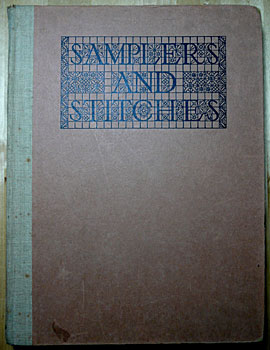
Mrs Archibald Christie’s Samplers and Stitches, which came to me from my grandmother Peggy Richardson, née Brodie. She learned beautiful art embroidery in Glasgow in the 1920s. I would love this challenge piece to be connected to two people who shared with me their deep love of history and the significance of the past.
Postscript: While I was searching Google I discovered that George Richardson left an archive of archaeological papers, which are in the Tullie House museum in Carlisle. I never knew… how amazing, I can go and look at these and maybe fill in some more of the gaps.



