
Close attention to the echoing shapes of shadows can be rewarding.
Theo Moorman, Weaving as an Art Form, p53
one warp, three weaves
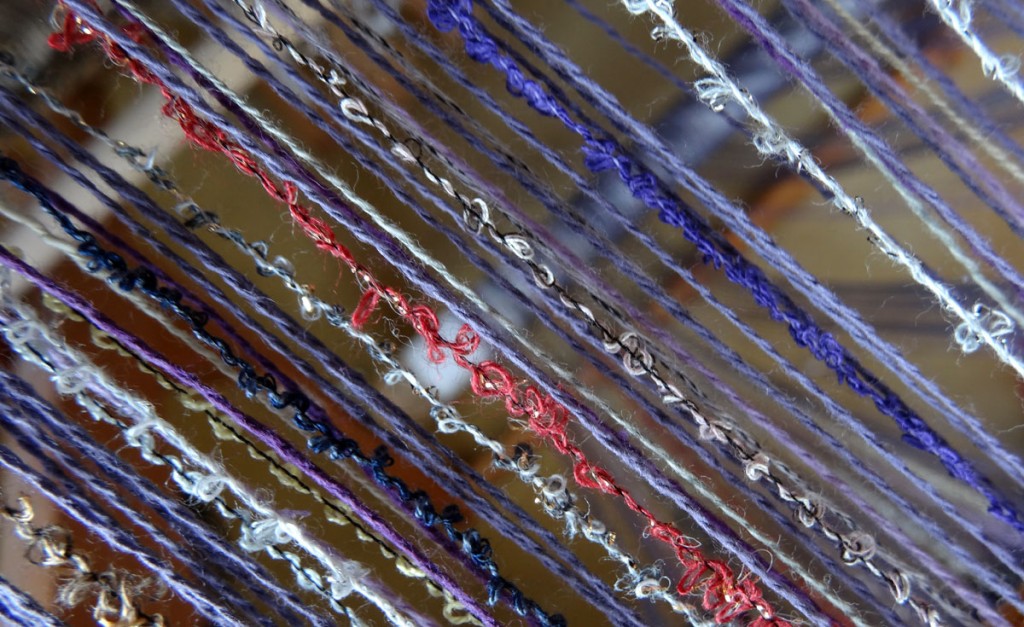
At Woolfest this year, I bought a pre-wound warp from the Saori Shed – mostly purple cotton with a bit of texture and sparkle. I’ve been winding my own warps since I used up the pre-wound warp that came with my loom and I enjoy the process and the choices; but this was a bit different and a special treat.
In these scarves I was playing with cramming and spacing the warp and its effect on the patterns – twill on the left, plain weave on the right.

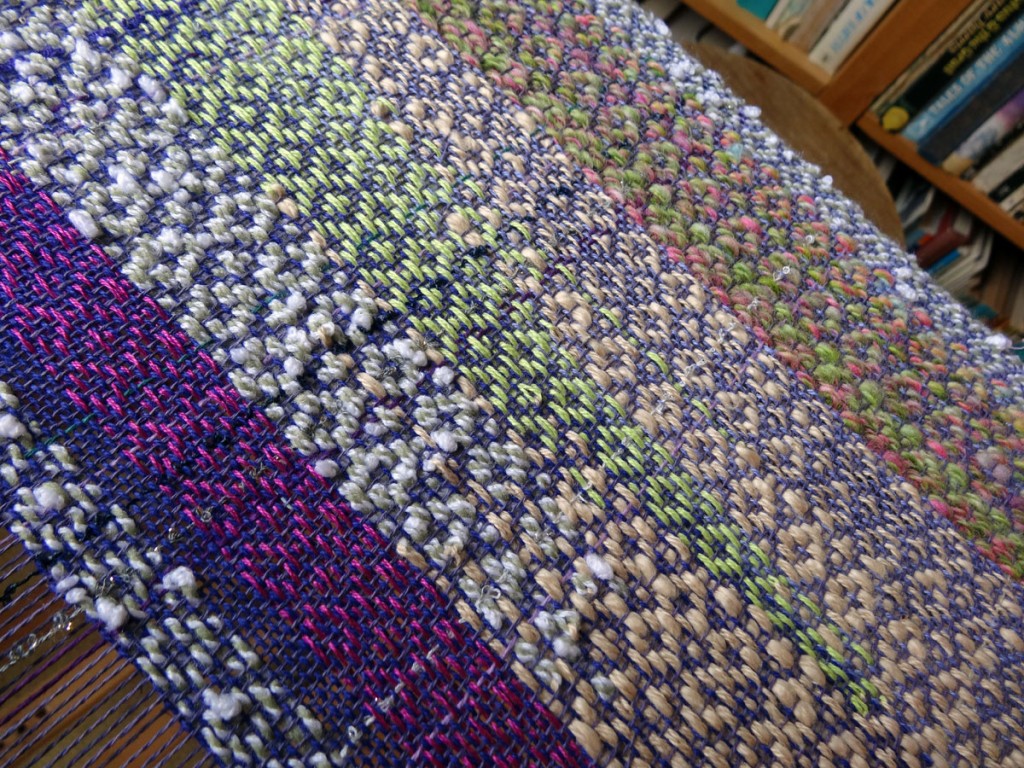
Both the scarf patterns were woven on the same threading, but I didn’t think there was enough warp left for a third and in any case I wanted to try some Saori play with pattern. Two weavers who use pattern in ways I find very inspiring are Susan Johnson of Avalanche Looms and Judy of Fibres of Being. I particularly like Judy’s Saori-style interpretations of the rosepath pattern. So I’ve rethreaded the heddles and have been trying rosepath in various yarns. It’s exciting to see all those wonderful little dots appearing as if by magic… Are they not-quite-diamonds or almost-circles? I’m not sure but I love them.
week 2 assignment
We had choices this week, one of which was to think of a new question, related to an issue of relevance to a group of people in your community, and trigger dialogue among this group of people.
I decided to alter a number of aspects of the conversation, compared to last week: a tiny group, a different setting (meal in a café). We were to talk about a very specific idea, with a potentially concrete but physically transient outcome: the possibility of organising an event that I think would be relevant here on Tiree, might even be transformational in a tiny way. It’s not a huge project, but big enough to be daunting. I’m a recovering perfectionist, and part of that is learning that baby steps get things done. If I think as big as I dream I overwhelm myself. To bring this project about will require input from some professionals and help from a number of people with practical skills I don’t possess. But an important first step is just to chat around the idea in a non-committal kind of way, so I took a very small group of people out for lunch, people I know well and have talked to before about the issues we’d be working with.
Thinking wider, I wonder if choosing such a small, familiar starting point is crucial to me as a way of making things possible. When I think about participatory art, it’s all local, I don’t (yet?) envisage going into someone else’s ‘place’. Though, of course, as I’m an offcomer, Tiree is in fact someone else’s place, not mine. It’s a place I feel ‘fits’ me, but like putting on a garment, not like fitting in your own skin. I don’t know what it feels like, to belong in one place for a lifetime. I was born in Germany, but grew up in Cumbria which was my father’s mother’s place for centuries. My father’s father’s forebears were Irish. My mother’s parents were Scottish but she had an itinerant childhood and lived more often in England than Scotland. If I have a ‘skin’ place myself, it’s the Eden Valley. But really I’m a stranger there now too, and Tiree is the closest to being ‘home’ that I’ve felt for a long time. I’m rambling, but I think what I’m feeling towards is an understanding that my way of working may depend on being part of a local context myself, framed by people I know, who know me. I’m not likely to suddenly become a traveller at heart, or a person who knows fast ways into new contexts or a person who wears a watch. But slow is OK, and so are short distances and of course baby steps.
Anyway, back to the conversation: we weren’t talking at this stage about practical issues, except in passing, but about whether the event would work on the island and how it would need to be adapted to the context. It’s related to an area that is often hidden or not spoken of and where people may be vulnerable and feel exposed, so we talked about how to embrace that and make it possible for people to engage without fearing that others might be making any particular assumptions about their motivation. This is a crucial issue for participatory art in a tiny community if it is to tackle anything that may elicit shame or judgement.
Not forgetting that this was also an assignment, we had been asked to introduce an element of disruption 15 minutes into the conversation (for example, put on costumes, move outside, close our eyes). I decided to link this with something I had been thinking about after the assignment in week 1 – how to capture the content without changing the conversation too much. I had been making notes anyway in this week’s conversation; it was easy to be doing that without affecting the flow as it was more like a meeting, though also a shared meal. But after 15 minutes I put a voice recorder on the table and, after checking everyone was OK with this, I switched it on. Complete silence for some moments… then we started to talk again. The original conversation gave way to a focus on how it was making us feel. Various points of view were expressed about how the conversation might be affected by recording it, which possibly divided along generational lines:
- It makes a lot of difference, people are more self-conscious, slower to speak and more careful about what they say, more anxious about saying the ‘wrong’ thing. This could lead to a more reflective conversation or a less frank one. It could militate against creative thinking or taking risks.
- It doesn’t make much difference – we inhabit a world of social technologies and have developed a constant awareness that what we say digitally is ‘out there’ anyway at the touch of an enter button, so the potential drawbacks or benefits of being recorded are already in play.
In practice, after a short while we grew used to the equipment, and feelings of self-consciousness dissipated, but we did remain aware that we were ‘on the record’ until I switched it off. We didn’t really pick up on our original topic of conversation in the same depth until after that, suggesting that the recording was a significant intrusion, even in the quite public setting of a café.
I was recently at a meeting where a visit by the media caused embarrassment and reluctance or refusal to participate. Some people are very uncomfortable even having their photo taken. Yet many transient social art events are recorded in some medium – photography, video, audio, tweets, Facebook, etc – and if they weren’t they wouldn’t be accessible to anyone who wasn’t there – but I wonder how much it alters the event fundamentally (puts people off participating or adversely affects their level of engagement, for example)?
Regarding the conversation as a whole, I think that by creating a small, safe context for discussing something quite difficult and personal, the dialogue was quite intimate and focused. I was able to gain a better understanding of the aspects of the project that are particular to this place and the responses there might be. I have also felt encouraged by the courage of others – both in this conversation and in the previous one. It’s interesting to me how a participatory approach can simultaneously reveal complexity and bring clarity.
quote
The highest delectation of the human mind is the perception of order, and the greatest human satisfaction is the feeling of collaboration in rhythmic relationships.
Amédée Ozenfant, quoted by Ray Simpson, A Pilgrim Way, p101
thinking and threading
This morning I’ve been threading heddles, which is a good time to reflect, and listening to this very powerful and thought-provoking TED Talk.
These are some other participatory projects I’ve seen recently and find interesting for one reason or another.
The Napkin Project
Depressed Cake Shop
Impact Arts Craft Cafés
Wool against Weapons
Story of Mum
