
I haven’t worked much with prefelt but I recently got some different kinds to try (from Wingham Wool Work) and these are some exercises I’ve been doing with lines and marks using different prefelts and different fibres.
This is Blue-faced Leicester on black Merino prefelt, before and after felting. Some of the fibres were wetted before laying them down, or laid onto wetted prefelt, and these retain more definition, I think.

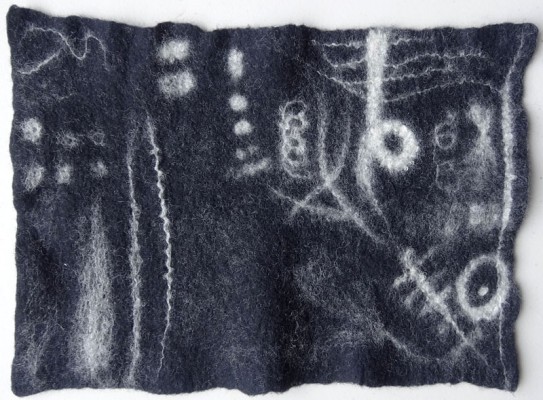
Update: I realised when I looked again at the notes I made for this next one that I had mixed up the order of the first two – it’s Shetland on the left and BFL next (now corrected).
This is the same prefelt, but exploring different fibres. Each group of three lines shows: untwisted fibres, dry twisted fibres, wet twisted fibres. From left to right the fibre is: Blue-faced Leicester, Shetland Shetland, Blue-faced Leicester, Merino, Teeswater, Massam. I love using Merino for felting but to be more sustainable I would prefer to find a UK alternative, the more local the better, and only use Merino when nothing else will do. Of these fibres the Shetland BFL has a lovely quality of line and is much less ‘hairy’ than the Teeswater and the Massam, almost as smooth as the Merino. The BFL Shetland is somewhere in between.

This is Merino on white Merino prefelt, I do love these lines.

This is Shetland fibre on Norwegian prefelt. It’s a much coarser prefelt but I like it more than I expected.
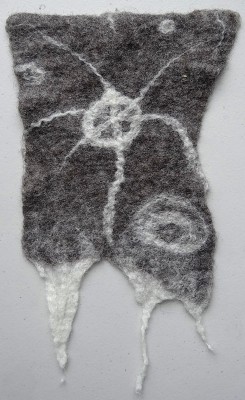
Here I made the prefelt first myself from Merino fibres (because I wanted the colours), laying out the fibres in random directions and then using a version of the dry rolling method described by Treetops Colour Harmonies in Australia. I used Merino for the lines too, dampened and twisted by rolling a little between my fingers. It’s just a small experiment in drawing with felt. I really enjoy the way the line crinkles as the felt shrinks.

One of the advantages of Merino, apart from softness and sheen, is the huge range of ready dyed colours. Does anyone have a source for dyed Shetland (and BFL!) tops in more than a few colours? And/or any other breeds to try? Bowmont? I do have some lovely Shetland cross fleece grown here on Tiree, in a couple of natural colours which I’m going to try dyeing myself as well.

