playing with colour

One final post about the ‘Textile Structures’ module – though actually it’s the first exercise – working from a visual source and analysing colour, texture and proportion. Choosing an image and first painting blocks of colour, then wrapping card with yarn, is intended to make you look closely at the colours and their qualities and proportions. I lost some of the lightness of the image in my painting and in the yarn wrapping but regained it, I think, in the fabric wrapping, which is much more visually textured.

analysing colour texture and proportion

I liked the result of wrapping with fabric a lot so I made another, this time just working with the colours in the fabrics. When it was done I realised that the sketch book page on which I’d used up my left-over paint would make just the right background for it!

colour wrapping

Wrapping is often used solely as a design exercise but an artist here on Tiree has made it into her own very distinctive art form. Susan Woodcock creates evocative seascapes and landscapes, full of colour and movement, combining paint and textiles in a way that perfectly captures the island atmosphere. Her husband Colin Woodcock, is also an artist, a painter whose work explores ‘the interplay of land, sea and sky’, and is filled with the beautiful light that is so special to Tiree. Together they run the Blue Beyond Gallery, where Colin also creates his dramatic raku pottery. Every week in summer you can go to watch the pots being fired – a fascinating process – and very hot!

tied up in knots

I’ve enjoyed all the exercises in the ‘Textile Structures’ section of OCA Textiles 1. One exercise involved making a frame and wrapping, binding and interlacing materials in an improvisational way to create areas of solidity and space, light and shade. I made a little frame from bamboo skewers lashed together and using white and natural yarns and threads, traversed the space with knotting, binding and needleweaving. I used a book by Ros Hills – Colour and Texture in Needlelace – to learn some new stitches.

knotting and needleweaving

textile structure and shadows
1, 2, 3, 4

The next exercise asked you to construct a grid, but I used a ‘found’ one – a pallet from one of Alan’s beachcombing expeditions and added verticals of rough macramé jute to weave through and tie to. I wanted something in keeping with the materials I was planning to use to create this textile structure – rope, twine, scraps of balloons from an old celebration, fragments of net, shells, seaweed – the randomness cast up by the tide on a Tiree beach. There’s a little white fleece from the fences there too, and a little dark Hebridean fleece brought back from this woolly place on Mull across the water.

beachcombing

There are some detail shots of the different sections here.

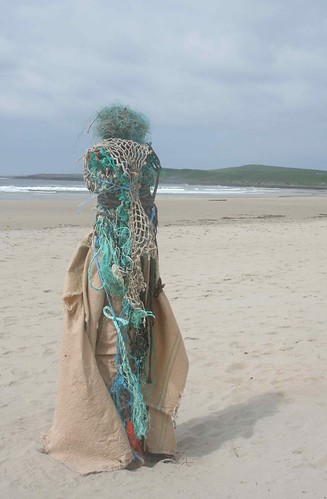
I’d love, one day, to see this beach twine sculpture on the island of Gigha. I did see this dramatic figure at Machir Bay on Islay a few years ago. I love coming across unexpected art like this.

beach woman

sacred in ordinary

The little tapestry that came out of thinking about laundry, sacredness and prayer rags is done (and even packaged and waiting to send off to my tutor!). It came out very close to what I envisaged. As I wrote in the previous post, I chose the word ‘sacred’ from a list in my course book, and focused on the idea of the sacred in the mundane, as expressed in Kathleen Norris’s book ‘The Quotidien Mystery: Laundry, Liturgy and Women’s Work’. I sketched a design for a stylised drying green but didn’t think I would be able to execute it technically, and then I started thinking about rag trees, which I’ve seen in Cornwall and Ireland, which led me to prayer cloths, found all over the world in various forms. I love the idea of cloth embodying prayer.

I decided to work with a combination of wool tapestry and cloth rya knotting that could evoke both rag trees and clothes lines. I auditioned various yarns for the tapestry but decided to spin my own in the end. I was trying to achieve a spacious meditative feel for the background, blending colours of sky, clouds and leaves.

spun yarn
spun yarn

Each scrap of fabric knotted into the tapestry has meaning for me, associated either with a person, an idea, or a memory. I like the result overall but I would change some of the sizes of the pieces, as I don’t think the balance is quite right – I was trying to create the kind of wildness you see in a rag tree, and if several neighbouring pieces are too similar in size it looks like a fringe and that freedom is lost. This happens in the third line down, which is the one I’m least happy with – it also breaks the rhythm of the diagonals and I think the line should be less horizontal. I was trying to create some variety in the diagonals but that one looks stolid instead of dynamic. I like the way some of the fabrics fray and curl up – this creates the ‘alive’ feeling I was hoping for. I photographed the piece outside where the wind could touch the cloth to emphasise this.

tapestry
tapestry

I’m not sure whether the piece works in the end or is just too literal. I wanted it to be abstract and symbolic more than representational. What do people think? I couldn’t have made it any bigger as that was limited by the size of my frame, but I wonder if it would have been stronger at a larger scale. Technically there are problems with ridges in the weaving which I think comes from using a simple frame with a single shed stick; and I would need to do a lot more weaving to find out why it twists in opposite directions at top and bottom.

I’ve also been working on my theme book for the final assignment of the course, which has an absolute deadline of 16th June. My theme is ‘hospitality’, thinking particularly about asylum and sanctuary for all kinds of people who might not be made welcome by everyone. After reading a little piece in Country Living about ‘How to Lay the Perfect Table’ I decided to focus on ‘How to Lay the Imperfect Table’. These are some of the pages from my theme book. Most of what I’ve done so far is playing with the ideas but I’m ready to start sampling now.

theme book
theme book
theme book

tapestry

The main focus of this stage of my OCA Textiles 1 course is tapestry weaving. There are several exercises, leading up to a resolved sample. The first is to try out different techniques. I used Kirsten Glasbrook’s book Tapestry Weaving which has a lot of hands-on information and excellent photos of various techniques to build into a sampler; and a book by Nancy Harvey, also called Tapestry Weaving, which goes into much more detail but is not so clear visually (at least not for me because I find it easier to see what’s happening from photos than diagrams. If you’re the other way round, the Harvey book has lots of good diagrams).

This is my first sampler, trying several different techniques, and a limited range of yarns – some plain tapestry wools (not rug yarn but the kind sold for needlepoint) and some Noro yarn. I’m trying to use up some of the materials I have already, to overcome a bad habit of always feeling I need the ‘right thing’ to hand.

tapestry sample

The next exercise was to create something expressive using a range of different materials; I was thinking fire or more specifically ‘deep into his fiery heart, he took the dust of Joan of Arc’ (from a Leonard Cohen song I’m listening to a lot right now). This one includes combinations of fibres and found materials – sari ribbon, embroidery threads, polythene bags and plastic netting, video tape, wire, handspun yarn, cord, torn fabrics, net, beads, knitting yarns and tapestry wools. I’m noticing I lean towards working on quite a fine scale.

tapestry sample - texture

The third exercise was to use rya knotting in addition to the tapestry weaving, to create texture. Again the scale is small, and this uses handspun, plastic bags, net, silk and novelty yarn, inspired by the sea.

tapestry with rya

The final sample involves choosing a word from a list and working a sample based on a storyboard. At least, they call it a storyboard but that means something different to me – I think what’s wanted is what I think of as a design board. I chose the word ‘sacred’ and as I’ve recently been reading Kathleen Norris’s ‘The Quotidian Mysteries: Laundry, Liturgy and Women’s Work’ that seemed like a good place to start. Clothes lines led on to prayer trees and also reminded me of this TIF Challenge piece on memory. Here’s the design board – the weaving is still in progress.

design board

paper weaving

This exercise was to create structures from strips of paper, card and other materials.

paper weaving
two sheets of painted card interwoven

paper weaving
cutting the paper weft into curves

paper weaving
magazine page woven with scrunched tissue paper

adding diagonal lines

weaving strips of a plastic bag

I like the middle one because of the texture and the way the weft breaks up the image; and the bottom one, with the effects of transparency, and the fragments of words.