more felt

I’m not sure about either of the pieces of felt I made today but at least I made them 🙂 One is an experiment stitching into prefelt before felting – more play with a piece of fleece. The images show before and after the felting was completed:

embroidered prefelt
embroidered felt

I want to explore this effect some more, but would prefer finer wools for the stitching, I think.  Then, rather than getting all wet and soapy for one little piece, I also made another piece of felt based on thoughts of the sea at sunset. It didn’t really turn out as I wanted, but it’s all experience.

felt

Mechanical Drawing – the Schiffli Project

That’s the title of an exhibition I’ve just been to see at Farfield Mill. The last working Schiffli embroidery machine in the UK is at Manchester School of Art, and for this exhibition fifteen artists worked with the machine, creating pieces that are both hand drawn and machine embroidered.

While I’d heard of the Schiffli machine, I had only a vague idea of the process – it’s actually a pantograph principle where the artist draws the line large using a hand-held device, moving across their design and clicking wherever they want the needle to enter the fabric; and the machine, which has 86 needles, reproduces the line in miniature many times across the fabric.

Each small movement of the artist’s hand is there in the stitched line, so it has a very human quality, a feeling of directness and immediacy. As each needle can hold a different coloured thread, or variations on one colour, or every thread can be the same, or some needles can be left unthreaded, there is potential for exploitation of tone, colour and pattern on a grand scale.

I was very impressed both by the impact and scale of the work, and by the quality of the exhibition. The textiles were well displayed with plenty of light and space; there were samples available to touch; and in the background there was the constant rhythmic sound of the machine at work (the sound was an element of one of the works – Kate Egan’s installation ‘Stack’), which added another sensory layer to the experience. It was a really engaging celebration of a fascinating machine that’s clearly cherished and enjoyed by those who work with it.

It’s difficult to pick out just a few pieces for a special mention… I loved the colour and movement of Rowena Ardern’s ‘Endangered’, which used the repeats created by the machine very effectively; I enjoyed Jill Boyes’ careful exploration of effects made possible by the Schiffli; I was moved by Jane McKeating’s poignant and humorous rag books, drawing on her sketchbooks from a period after she suddenly became single; and I would have loved to go home with Stephen Dixon and Alison Welsh’s ‘Armchair Politico’, which was both beautiful and thought-provoking.

The catalogue is excellent, with several essays, plenty of images and detailed text, and a DVD about the technical processes (which was also on show at the exhibition).
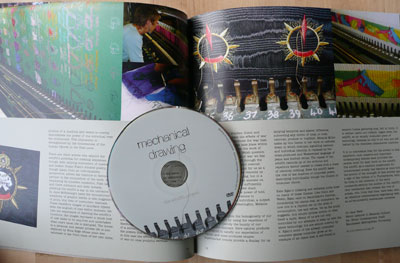
exhibition catalogue

Mechanical Drawing is at Farfield till 29 June and is also travelling to the Macclesfield Silk Museum and the Knitting and Stitching Show. Really worth seeing if you can; if not, all the pieces are represented online, along with excerpts from the catalogue, and a short video, at
http://www.miriad.mmu.ac.uk/craftdesign/schiffli/.

April TIF Challenge 3

Well, I ran out of time before I ran out of ideas, so I’m going to carry on playing with April’s Take it Further Challenge during May. I think it has some connections into May’s challenge as well so who knows where it will lead?

This, anyway, is where I’ve got to.

felt samples

The piece at the top left is partly felted. The little balls of yarn are naturally dyed as well – I got them at Soay Studio on the Isle of Harris (that’s the only link I could find, but I’ll go and hunt out a photo in a minute). I’m going to do big woolly embroidery stitches into the pre-felt and then finish felting it.

Next to that is a piece with some other coloured fleece added; and then my woven samples – I overdid the felting, so they’re very hard and small! Below them is a grid with thin strips of the pink roving in one direction and colours laid across it – I want to try this again on a bigger scale.

Bottom right are the samples of knitted fleece after felting – I like the coloured one in stocking stitch and this is another technique I’d like to explore – it was very easy to bring in additional colours exactly where I wanted to.

The middle piece at the bottom is very thin and webby and the piece on the right is the one I nuno felted into muslin. It was quite a dense muslin, and having seen the lovely lacy textures of Monika’s nuno felt, I’d like to experiment with some different fabrics to see how the effects vary.

The piece underneath the nuno felt is ‘just’ plain felt. Warm, soft, comforting – and pink – it has so much in common with the fleece it came from and yet it’s not the same at all. I plan to chop it up into pieces and sandwich each between different translucent layers, to quilt into the layers and watch the subtle changes that will emerge, and the differences between them.

I just love the amazing, endless variety of textures and patterns and colours that we can make with textiles, and their physical, tactile presence.

And this is the gateway into the delightful dyer’s garden at Soay Studio on Harris, which we visited in August 2006.

Soay Studio

TIF Challenge April 2

My response to Sharon’s April TIF challenge is about craft as change, taking something raw and unformed but full of potential, and effecting a transformation through a making process. Something like ‘n things to do with a piece of fleece’ where n is currently undefined, but (though possibly infinite!) will be determined by how far I get by the end of the month. I’ll put it together as a series of journal pages.

pink fleece

I decided to start with fleece and it isn’t actually raw – it’s already been washed, carded and dyed – a lovely crushed raspberry pink merino, dyed with madder and logwood, which I bought last week from Fiery Felts at the Embroiderers’ Guild North West Regional Day.

So far I’ve done some small experiments with weaving, knitting, needlefelting, and hand stitching, and I’ve started doing some felting.

weaving with fleece

I wove some of the fleece with a wool mohair warp and some with a fleece warp – I did two of each so I could felt one.

playing with fleece

Creative mayhem…

fleece ready to felt

Ready to felt – thick and thin layers of pink fleece, adding colours to the pink, felting onto muslin, knitted and woven samples. More to come when these are done…