Plan A

I’m working on ‘A Piece of Your Own’ which is the first extended assignment of the OCA Textiles 1 course I’m doing. I never really got going again on the course after moving house last year and though I’ve only completed half of it, I would have run out of time round about now, but the OCA has kindly given me an extension and a new deadline of early next summer. Right now I’m not sure whether that’s a good thing or not!

The textile piece is to form part of an item such as a garment, cushion, bag, wall hanging – it doesn’t have to be the whole item, and you are asked to keep an open mind about the end product for as long as possible.

The piece has to be developed from design work and techniques accumulated throughout the course so far; I gathered a lot of previous work together and did some design development on the computer back in July, and then some felted samples using ideas that came out of that. Gathering felt was one idea that I’ve already blogged about; these are some more experiments with that, before and after felting.

felt
felt

Then I took another of the computer designs and have been playing with it. I tried stitching needled merino before wet felting (using yarn made from the same fibre so some of the yarn would ‘disappear’) and felted half onto muslin and half onto white fleece.

circles

felt
felt

Nothing is really working though and I desperately want to get this module over with since I’ve been stuck on it forever… It’s not that I’m not producing textiles at all – I’ve made several felt scarves over the summer – this is the latest.

textile

I wish I could just use this scarf for my textile piece! I’d be tempted to but there’s no link with any design work, which has to be the starting point, or if there is, it’s inside me somewhere. When I make something in ‘real life’ I usually have an idea to work to – in this case a wrap and the word ‘flame’, or something I’ve seen or heard that’s inspired me, and the materials do the rest. Sometimes I write down words that extend the idea, like a mind map. My imagination tends to be verbal and then tactile. I don’t seem to be able to start visually, with drawings and designs, and then progress to something that means anything to me. When I draw or paint that seems like an end in itself. I don’t understand why I find a visual design process such a struggle, but it feels like there’s a magic casket and I can’t find the key – and it’s frustrating because I’m sure my work would be stronger and more defined if I could get to grips with it.

Anyway, enough moaning, my plan is to persevere with the circles design and to try and interpret it in fabric manipulation (using nuno with silk). Silk painting was one of my favourite bits of the course, so I’ve painted a big piece of silk to sample with and, well, I still prefer the original computer design, but if I don’t compare it with that I am quite pleased with it, apart from the dark splodgy bit in the middle where I used too much salt! I want to see how it looks with the background ruched and the circles felted, and vice versa, and if either works it could be a cushion cover or part of a bag or scarf. That’s Plan A, at any rate…

silk painting
silk painting
silk painting

textile tv

Thanks to Joanna at Things [Handmade], I just learned about a very exciting new TV series, Talking Threads, which is going out on Sky and on the online TV channel countrychannel.tv, and will be made into a DVD as well. The series starts in mid-October – may it be the first of many.

I’d not come across the Country Channel before but it has some other goodies too, including a short feature on Farfield Mill in Cumbria and a 3-part series called Inspirations – interviews with different textile artists about their inspiration and process.

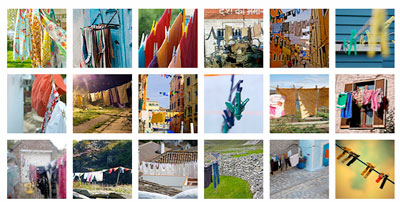
The other thing that caught my eye this week was the new Galleries feature on Flickr. You can collect up to 18 images by Flickr users "around a theme, an idea or just because". So I’ve made a small celebration of the washing line.

Flickr galleryon the line

in a spin

Since I came back from Woolfest with this

Intertwined

I’ve been inspired to begin learning this

spindle and yarns

And this

plying

So (slowly) I’m amassing a small haul of slubby wayward yarns that should be useful for the weaving assignment in my next OCA Textiles 1 module, and for felting as well.

yarn

I tried a bit of crochet and like the random stripiness a lot…

crochet

I am loving spinning! It’s so addictive – colour flowing from one hand to the other, making magic as it goes. I don’t seem to be able to stop. And now I’m dreaming about one of these…

kromski sonata
1. i love spinning, 2. wool3, 3. Kromski Sonata, 4. IMG_0272
made with Big Huge Labs Mosaic Maker

gathered felt

I only had time for a short felting session this weekend; and, in the first of the samples for my ‘textile piece’ assignment, I started with this digital image:

digital image

This has elements of marbling, ripples distorting the original stripes, creating movement and asymmetry, forming new relationships between the lines.

Influenced by the way shibori captures the stitches into the surface of the fabric visually, even though the thread has been removed and even when the fabric is flat, I thought, what if the effect of stitching into fleece before felting could be captured in a final flat surface?

I laid out 3 gossamer layers of merino – white, then stripes of colour, then a soft pale pinky brown. I intended the top colour just to tone down the layer beneath it but it actually enhanced the surface in a way I didn’t anticipate.

I needled the layers of fleece lightly, just enough to keep them together while I put in the gathering stitches. I have a wonderful little multi-needle tool made by Dianne Stott called the Fabulous Felt-O-Matic which was invaluable for that job; otherwise I’d have wet prefelted the layers as minimally as possible before stitching. This piece started off about 60 x 50cm; shrank to 11 ~ 22cm x 40cm. On a larger scale, it would have to be needled more tightly or wet prefelted before stitching because of the difficulties of handling a very lightly needled fleece in large pieces.

Here’s the stitched and gathered fleece:

gathered fleece

To stitch, I used crewel wool in blending shades, and left it in; I could also try a synthetic yarn that would pull out after prefelting, or else a more dramatic yarn that draws attention to itself. I then went though the normal wetting out, felting and fulling process, and this was what happened.

gathered felt

Held up to the light, you can see the way the gathers form thicker and thinner areas of felt – it would be interesting to try with undyed fleece, to maximise this effect. The whole piece is thin but strong; even where there is more fleece it isn’t bulky, because the layers were so thin to start with. If you run your fingers over it you can just feel slight indentations where the gathers were, but against the light the ghosts of the folds appear.

gathered felt against light

I was very pleased with how the stripes distorted; and interested in the way the top layer moved with the gathers, forming a netted pattern over the surface. I have new ‘what ifs’ now. What if I use wider stripes? What if the top layer contrasts more strongly with the one below. What if I pull up the gathers more tightly, make them closer together, or further apart? What if I start with a grid? What if a larger piece was made up of several smaller pieces, and what if the gathers ran in different directions from one piece to the next? if I want to explore any of my other design ideas before settling on one for the textile piece, I’ll need to keep most of these questions till after the course is finished!

International Day of Felt

October 3rd 2009 will be the first International Day of Felt, organised by Felt United, a non-profit group of felt artists, as 2009 is the United Nation’s Year of  Natural Fibres.

The vision is that felters all over the world will join together to display their felt outside their homes, and the theme will be a slice of the colour wheel, from yellow through red. This sounds so exciting:

“People around the world will be surprised by finding yellow felt on doorsteps, orange felt birds in parks, children wearing red felt vests and husbands carrying bright felt bags to work. There will be felt in museums and felt in markets. There will be felt groups organizing open days and workshops. …felt in trees, on cars on bicycles and on mountaintops.”

Information about Felt United, the International Day of Felt and the call to artists is on the Felt United web site.

felt united screenshot