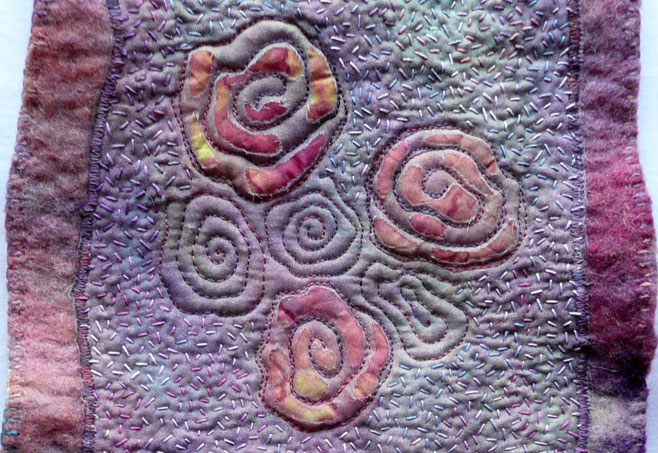
well, it’s done…

… the ‘when will this ever be finished’ wall hanging for City & Guilds Patchwork & Quilting is now finished!

This was my first experiment using felt as the batting so it became an integral part of the design. The assessment was to make a piece using appliqué techniques. It has three layers – painted silk organza, handmade felt, and painted silk pongee. The shadow appliqué shapes are hand dyed cotton and hand painted silk, and the machine and hand quilting are in cotton.

I cut back the top layer of some of the shadow appliqué and machine quilted areas after quilting them. I finished the edges with buttonhole stitch and then needlefelted them to break down the stitches into the felt. The support is a piece of driftwood I found on the beach, and the work is 53cm x 78cm (or 76cm x 78cm if you include the wood).

applique hanging

applique detail

applique detail

applique detail

applique detail

assignment 2 is done!

I knew it had been a while since I last blogged but I was a bit surprised to see just how long. I have a good reason, though – I’ve been immersed in finishing my second assignment for OCA Textiles 1, finally put in the post (just) on time on Monday. It takes ages to get everything labelled and organised for sending to my tutor – I must try to do more of that as I go along. These are the two larger printing/painting samples I finished at the weekend. The top one is a repeating pattern that could go off the edges of the fabric – scrunch dyed cotton fabric, block printed with fabric paints, then stencilled with masking tape stencils in two layers, the first layer applied with a natural sponge, and the second layer applied with a sponge roller. When I’d done that, I thought the purple stripes were too strong against the background fabric, which was quite pale in places, so I painted the whole thing with thin turquoise paint and then rinsed it before setting.

The bottom one is a single unit inspired by log cabin patchwork. It’s all block printed, the ‘log cabin’ with funky foam blocks with holes punched into them, and the round shapes with carved erasers. The fabric is silk, and I used fabric paints as I wanted that brushy texture in the colour.

printed fabric

printed fabric

The next section of the OCA course is fabric manipulation and making an actual object like a bag or a waistcoat, which sounds great, but I must also finish the appliqué piece and get on with the final assessment for City & Guilds. I think if I really pull out the stops I might be able to finish it before my registration runs out in mid-December.

Draw Something Every Day

doodling

The Draw Something Every Day challenge. This started off with me thinking about pastel colours for an assignment. I saw a big heap of candy coated chocolate eggs on a market stall and started doodling shapes and arrangements for a potential design.

The assignment was to do colour mixing with pastel colours using a pointillist stitch technique in a design derived from an image. I tried to do some painting and drawing in pastel colours using shells and stones and flowers, but there was nothing I wanted to take further. I found it came more naturally to work the colours directly in the stitching in a more abstract way. It is inspired by the candy eggs and the doodles but has taken on a life of its own.

pastel French knots

more French knots and other dots

I hoped I would get a bit more done last week, art-wise, than I did, but there was more work (day job) than I expected (which is good, really) and so in the end I was squeezing the art in around it. I did the machine quilting on the second of three panels for the appliqué assessment in my quilting course, and started on the hand stitching. It’s crazy, really, to be doing large amounts of hand stitching on a project like this when time is short, but I am, because when I decided to do that, it turned from an assessment piece I ‘had to get done’ into something that I feel engaged with and might even want to look at again afterwards.

For OCA Textiles 1, I’m still working on the pointillist stitching exercises. I tried some different stitches…
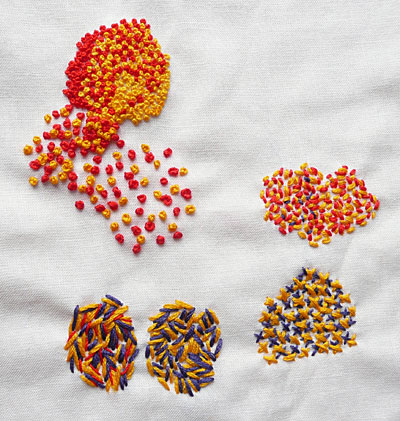
pointillist stitching

… and then French knots at a different scale, though not (yet) with rope as envisioned by Jude in her comment! This was just tapestry wool on canvas.

pointillist stitching

I enjoyed this exercise, which was to blend pastel colours across a sample. Though I had to scrape the barrel a little to find any pastel colours at all in my thread collection – just a few silks left over from something I made for my niece when she was a baby (she’s practically a teenager now and I don’t seem to have bought any thread you could call pastel since then – a few knitting yarns, that’s all).

blending stitches

The next exercise is to interpret something from my sketchbooks, also in pastel shades, in a pointillist style. Well, a quick glance through them reveals that even when I paint something that looks pastel-ish, I make it stronger or brighter or even a different colour! So I think the next exercise is actually to sit down with my sketchbook and some paint that includes liberal amounts of white, and see how pale and interesting I can be…
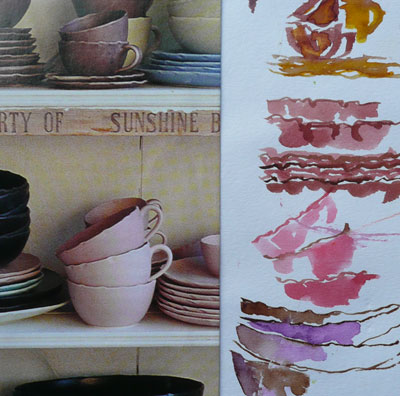

painting crockery

getting on with some Textiles exercises

I’ve been conscious that though I’ve been doing lots of of textile-y and colour-related things, which I’m sure contribute to the learning curve I’m on with OCA Textiles 1, I haven’t done any actual exercises since August, so yesterday I sat down and did the next two from the course folder. The first involved choosing images that have a colour scheme I feel drawn to and collecting fabrics and threads to match the colours. This was fun – I chose a couple of postcards – one is of the stained glass window designed by Patrick Heron for the Tate in St Ives, Cornwall, and the other is Liesbeth Lange’s photo of ‘Colours from Nepal’ – I guess they are dyes, but I don’t really know.

matching colours

The second exercise was to stitch onto a black background using two primary colours. I am finding that the more I hand stitch the more I enjoy it – it takes time, which I lack, but the patterns are so lovely and I’m fascinated by the variations that grow between one stitch and the next.

stitching with primary colours

I’m off now to make a few sample paper beads to take to youth club tonight, but I must just mention a magazine I read about yesterday on MissMalaprop.com. Worn Fashion Journal sounds like a great publication for anyone who’s interested in fashion design, wearable art or the cultural meanings of clothing.