scarves

These are all woven with my handspun on a 12 inch Ashford Knitter’s rigid heddle loom.

textile

textile

textile

I made them at the end of 2010. It’s high time to warp the loom again, since the New Year it’s been all spinning and no weaving.

fibre

Work is frenetic at the moment but I am making time to go to a weekly patchwork class on the island – two peaceful hours with likeminded people, and lovely log cabin to play with.

And out of this something very exciting is being born – the new Tiree Tapestry Group – tapestry in the sense of community tapestry, using a wide range of creative textile techniques. We’ll have a web site soon but there’s a little bit about us on our Facebook page. Our first meeting is on Friday – I can’t wait!

the last lap: changing direction

For the first trial felt mat, I decided to needlefelt dots of fibre within a circular area, leaving a border of undecorated felt where I was going to try writing some text. I can’t post a photo as I sent off the samples with my assignment without taking any, but it was – just – OK – really I didn’t like it at all! I spent some time stitching into and applying bits of fabric and fibre to another piece of felt and while there were lots of nice effects that I may use in the future, nothing was singing to me. I looked at my solitary mat and imagined a few more alongside it, and I knew this wasn’t what I wanted to do.

Soooo… back to the theme book to pick up on another of my early ideas – a set of napkins in napkin rings. Napkin rings are physically the perfect shape to embody both the embracing, enclosing aspect of the circle and the openness I was trying to convey. Embroidering text onto napkins would mean that it could be rolled up and half hidden, to be revealed in the act of opening the napkin and preparing to eat. “Hospitality can begin a journey towards visibility and respect” (Making Room, Christine D Pohl).
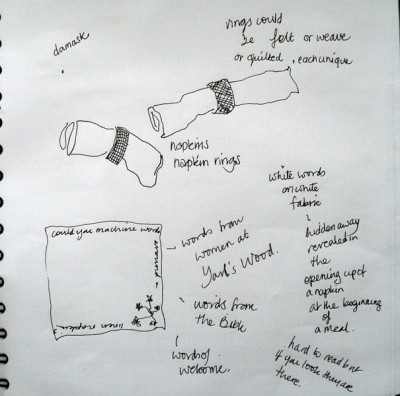
napkins in sketchbook

I still wanted a non-matching set, and at first I thought about making each napkin ring in a different way. I looked at various textile napkin rings and cuffs on Flickr, at how they were constructed and fastened. I sampled a quilted ring using indigo fabric, and I thought about weaving and embroidering, and I thought that they wouldn’t be a non-matching set but would just look as if I’d tried to include every textile technique I ever used! As Tim Gunn says, “Edit, edit”.

I thought about the cards I had wrapped with fabric and how exciting they were. I looked at my pile of blue and white fabrics from around the world, and my indigo shibori fabrics which include a few overdyed colours as well as much blue and white, and I decided to weave the napkin rings, all on the same warp, in fabrics using a free Saori style. Each one would start with a slightly different base point – Ghanaian batik, Indian block prints, sari silk, Javanese batik, and shibori, refecting cultural diversity. Indigo, forms of which are used in so many countries, would link them all together.

So I warped my little loom (for the first time!) and wove. I had been thinking about numbers, having decided that I wanted an odd number, as more in keeping with my theme, I settled on 5, since 7 is supposed to symbolise perfection and I didn’t want that. Thanks goodness, I would never have completed 7 in time!
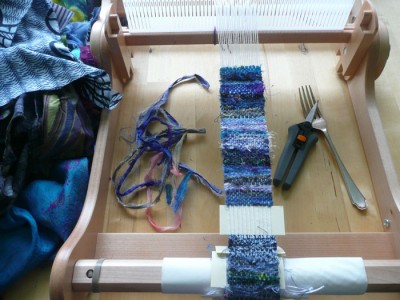
weaving on loom

woven strips

I found the perfect napkins on Ebay, all the same size, all white damask, but each with a different pattern. I love that they are used, not pristine, and have their own hidden stories, if they could only tell. On each one I wrote, with stitch, the words of a detainee held at Yarl’s Wood, a UK detention centre for asylum seekers, a place which epitomises the very opposite of hospitality – a scandalous place where traumatised women and children are made prisoners. Yarl’s Wood Befrienders go to visit and support the detainees, and the words are taken from their web site, with permission. They are very moving. I stitched them over and over in shades of blue, moving from pale to dark, to reflect something of the “journey towards visibility”.

napkin stitched writing

five napkins

So I should be done, at this point. But no, that really is something else in the background. In a moment of mania I decided, not for the sake of the assignment, but for the sake of the work, that it wasn’t complete. I’d wanted to incorporate some of the snippets of text that I had jotted down throughout my theme book, but I hadn’t wanted to mix them up with the words of the detainees, detracting from both. So I was thinking hard about how to include them in the piece in a way that was continuous with the rest and added to the whole, and what I did is the next instalment…

sacred in ordinary

The little tapestry that came out of thinking about laundry, sacredness and prayer rags is done (and even packaged and waiting to send off to my tutor!). It came out very close to what I envisaged. As I wrote in the previous post, I chose the word ‘sacred’ from a list in my course book, and focused on the idea of the sacred in the mundane, as expressed in Kathleen Norris’s book ‘The Quotidien Mystery: Laundry, Liturgy and Women’s Work’. I sketched a design for a stylised drying green but didn’t think I would be able to execute it technically, and then I started thinking about rag trees, which I’ve seen in Cornwall and Ireland, which led me to prayer cloths, found all over the world in various forms. I love the idea of cloth embodying prayer.

I decided to work with a combination of wool tapestry and cloth rya knotting that could evoke both rag trees and clothes lines. I auditioned various yarns for the tapestry but decided to spin my own in the end. I was trying to achieve a spacious meditative feel for the background, blending colours of sky, clouds and leaves.

spun yarn
spun yarn

Each scrap of fabric knotted into the tapestry has meaning for me, associated either with a person, an idea, or a memory. I like the result overall but I would change some of the sizes of the pieces, as I don’t think the balance is quite right – I was trying to create the kind of wildness you see in a rag tree, and if several neighbouring pieces are too similar in size it looks like a fringe and that freedom is lost. This happens in the third line down, which is the one I’m least happy with – it also breaks the rhythm of the diagonals and I think the line should be less horizontal. I was trying to create some variety in the diagonals but that one looks stolid instead of dynamic. I like the way some of the fabrics fray and curl up – this creates the ‘alive’ feeling I was hoping for. I photographed the piece outside where the wind could touch the cloth to emphasise this.

tapestry
tapestry

I’m not sure whether the piece works in the end or is just too literal. I wanted it to be abstract and symbolic more than representational. What do people think? I couldn’t have made it any bigger as that was limited by the size of my frame, but I wonder if it would have been stronger at a larger scale. Technically there are problems with ridges in the weaving which I think comes from using a simple frame with a single shed stick; and I would need to do a lot more weaving to find out why it twists in opposite directions at top and bottom.

I’ve also been working on my theme book for the final assignment of the course, which has an absolute deadline of 16th June. My theme is ‘hospitality’, thinking particularly about asylum and sanctuary for all kinds of people who might not be made welcome by everyone. After reading a little piece in Country Living about ‘How to Lay the Perfect Table’ I decided to focus on ‘How to Lay the Imperfect Table’. These are some of the pages from my theme book. Most of what I’ve done so far is playing with the ideas but I’m ready to start sampling now.

theme book
theme book
theme book

tapestry

The main focus of this stage of my OCA Textiles 1 course is tapestry weaving. There are several exercises, leading up to a resolved sample. The first is to try out different techniques. I used Kirsten Glasbrook’s book Tapestry Weaving which has a lot of hands-on information and excellent photos of various techniques to build into a sampler; and a book by Nancy Harvey, also called Tapestry Weaving, which goes into much more detail but is not so clear visually (at least not for me because I find it easier to see what’s happening from photos than diagrams. If you’re the other way round, the Harvey book has lots of good diagrams).

This is my first sampler, trying several different techniques, and a limited range of yarns – some plain tapestry wools (not rug yarn but the kind sold for needlepoint) and some Noro yarn. I’m trying to use up some of the materials I have already, to overcome a bad habit of always feeling I need the ‘right thing’ to hand.

tapestry sample

The next exercise was to create something expressive using a range of different materials; I was thinking fire or more specifically ‘deep into his fiery heart, he took the dust of Joan of Arc’ (from a Leonard Cohen song I’m listening to a lot right now). This one includes combinations of fibres and found materials – sari ribbon, embroidery threads, polythene bags and plastic netting, video tape, wire, handspun yarn, cord, torn fabrics, net, beads, knitting yarns and tapestry wools. I’m noticing I lean towards working on quite a fine scale.

tapestry sample - texture

The third exercise was to use rya knotting in addition to the tapestry weaving, to create texture. Again the scale is small, and this uses handspun, plastic bags, net, silk and novelty yarn, inspired by the sea.

tapestry with rya

The final sample involves choosing a word from a list and working a sample based on a storyboard. At least, they call it a storyboard but that means something different to me – I think what’s wanted is what I think of as a design board. I chose the word ‘sacred’ and as I’ve recently been reading Kathleen Norris’s ‘The Quotidian Mysteries: Laundry, Liturgy and Women’s Work’ that seemed like a good place to start. Clothes lines led on to prayer trees and also reminded me of this TIF Challenge piece on memory. Here’s the design board – the weaving is still in progress.

design board