stitching resists

While we were at Land’s End we sat for hours one day in the camper van while the rain poured down outside and I stitched some experiments to add to my little pile for dyeing. I made a square of squares, first overstitching a grid and then a different idea in each small square. In a fit of unusual methodicalness (or maybe all I need to be methodical is some dedicated time… ) I drew the stitch pattern for each square in my sketchbook so that if I like some of the results I can remember how I did them.

stitched resists and diagrams

I broke the thread a few times, which was very frustrating, and reminded me I wanted to get hold of some ‘seriously strong thread’ from Callishibori – I’ll put it on my list to look for at the Knitting & Stitching Show. I used ordinary polyester thread and I ran out of white – I’m sure I will regret the black when I come to unpick it!

The rest of the samples include some embroidery stitches pulled up tight and my first try at maki-age, stitched and bound resist.

stitched resists and diagrams

I haven’t decided what  to dye these with yet. I’ve been thinking more about the environmental effects of different dyes and mordants recently, partly because we’ll be on a septic tank when come November, partly as I’m (slowly) reading Eco-Colour, India Flint’s beautiful and thought-provoking book about using locally sourced materials for dyeing. At the moment I feel that I couldn’t change to only using plant materials but I would like to gradually use more of them (though moving to the windiest place in Britain may not help with the locally sourced part!). By the way, I found a very interesting and inspiring blog while reading round this subject on the web, Robin Paris’s Sustainable Batik, and another I’ve been reading for a while is Helen Methven’s Growing Colour. Lots of food for thought.

drawing breath

Life always gets away from me in the summer when time away (lovely as it is) means twice as much work to fit into the weeks afterwards – and it’s not long before we set off again, this time heading down to Cornwall. In between, a little space to draw breath and share what I’m up to.

Our visit to Tiree was momentous, to say the least. Alan’s on sabbatical next year and we’ve decided to seize the day and do something we’ve been thinking about for years – to live and work in a small community on a remote and windswept island. So we went there looking for a home – and found one! We’re now jubilant and terrified in about equal measure. The move won’t be till November but there’s going to be plenty to do before then. We have two daughters starting uni this autumn too, one moving from Cornwall to Liverpool, and one just moving round the corner in Birmingham, but both will need help with their stuff. I’ll need to work hard to keep time for art among all this excitement!

While we were on Tiree I at last joined in with the World Beach Project.

World Beach Project at Traigh Ghrianal

And I did a bit more sampling of gathered fabrics while I was away. The ones in the middle will end up being dyed, I think.

gathering samples

I got fascinated by the effect of visible stitching…

gathering samples

and tying…

gathering samples

Tomorrow I’m going to a short workshop with the intriguing title “Kendal Green meets Shibori Dyeing”. I think I’ve mentioned before that Kendal’s town motto is Pannus mihi Panis – “Cloth is my Bread”; and the arts centre is having a festival to celebrate the town’s heritage with lots of textile events. Kendal Green is an old dye colour mentioned in Shakespeare, but I think we’re going to use a modern version! It should be fun, anyway. I’m just wondering if I can take my gathered samples along and throw them in too!

And these are some pics of Tiree I’ve put on Flickr, colours of sea and sky, rust and sand, light and water.

Tiree mosaic

1. Gunna Sound, 2. rocks at Caoles, 3. light and waves, 4. Balevullin, 5. light, waves and seaweed, 6. fences at Balevullin, 7. cows on the beach at Balevullin, 8. rust and lichen, 9. Crossapol beach, 10. oystercatchers, 11. rusty machinery on Crossapol beach, 12. sunset, 13. clear sea, Gunna Sound, 14. rusty metal at Hynish, 15. Crossapol beach, 16. Balevullin

tiny steps

It’s funny how sometimes you seem to be making giant strides and things are falling into place all around you, and other times every tiny step (or stitch…) seems like a huge effort and then you stop altogether for a while. June has been one of those latter times for me, and this is all I’ve done, creatively speaking, since last time I blogged.

gathering calico

I love these effects (and of course I immediately want to dye them!). But I need to go much further and, for that, time must be set aside and guarded.

Plenty of other things have been happening, with work, family and life in general – good things, but time consuming. However, I was determined when I started the OCA course to not let the stuff that happens get in the way of spending at least 15 minutes on textile work each day, and I haven’t been doing that. I miss a day, then two, then a week…

Well, I wrote this to motivate myself and for a bit of accountability so I’m heading off to my workroom now, but before I go, a shout out to any members of the UK Embroiderers’ Guild who read this. Members have set up a web ring and a Flickr group to share work and celebrate being part of the Guild. Please join in and spread the word in your branch and region :-).

developing designs

I’ve been in a hiatus for months as far as my OCA Textiles course is concerned – stuck at the beginning of a module I really want to spend time on and enjoy – applied and manipulated fabrics. The exercise starts by asking you to select half a dozen previous drawings and develop them before interpreting them in fabric, and that’s the part I baulk at. I don’t know why I find it so daunting. Anyway, over the last couple of days, I’ve done it – six sets of design developments to inspire the fabric manipulation. I used the computer, and that helped, as did some suggestions my tutor had made about design methods in her feedback on the last assignment. I took ‘drawings’ to include photos and fabric printing as well as paint and pen.

sketchbook mosaic

1 2 3 4 5 6

The numbers link to the images on Flickr.

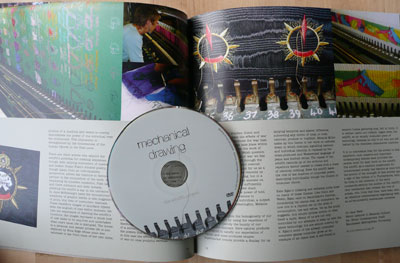
Mechanical Drawing – the Schiffli Project

That’s the title of an exhibition I’ve just been to see at Farfield Mill. The last working Schiffli embroidery machine in the UK is at Manchester School of Art, and for this exhibition fifteen artists worked with the machine, creating pieces that are both hand drawn and machine embroidered.

While I’d heard of the Schiffli machine, I had only a vague idea of the process – it’s actually a pantograph principle where the artist draws the line large using a hand-held device, moving across their design and clicking wherever they want the needle to enter the fabric; and the machine, which has 86 needles, reproduces the line in miniature many times across the fabric.

Each small movement of the artist’s hand is there in the stitched line, so it has a very human quality, a feeling of directness and immediacy. As each needle can hold a different coloured thread, or variations on one colour, or every thread can be the same, or some needles can be left unthreaded, there is potential for exploitation of tone, colour and pattern on a grand scale.

I was very impressed both by the impact and scale of the work, and by the quality of the exhibition. The textiles were well displayed with plenty of light and space; there were samples available to touch; and in the background there was the constant rhythmic sound of the machine at work (the sound was an element of one of the works – Kate Egan’s installation ‘Stack’), which added another sensory layer to the experience. It was a really engaging celebration of a fascinating machine that’s clearly cherished and enjoyed by those who work with it.

It’s difficult to pick out just a few pieces for a special mention… I loved the colour and movement of Rowena Ardern’s ‘Endangered’, which used the repeats created by the machine very effectively; I enjoyed Jill Boyes’ careful exploration of effects made possible by the Schiffli; I was moved by Jane McKeating’s poignant and humorous rag books, drawing on her sketchbooks from a period after she suddenly became single; and I would have loved to go home with Stephen Dixon and Alison Welsh’s ‘Armchair Politico’, which was both beautiful and thought-provoking.

The catalogue is excellent, with several essays, plenty of images and detailed text, and a DVD about the technical processes (which was also on show at the exhibition).

exhibition catalogue

Mechanical Drawing is at Farfield till 29 June and is also travelling to the Macclesfield Silk Museum and the Knitting and Stitching Show. Really worth seeing if you can; if not, all the pieces are represented online, along with excerpts from the catalogue, and a short video, at
http://www.miriad.mmu.ac.uk/craftdesign/schiffli/.