playing on the computer

I rarely use the computer for textile design work – as I spend all my working hours attached to one, I usually prefer to get up and do something physical – but I’ve been grappling with a creative low and just wanted to get some ideas out quickly and maybe get a kickstart as well. I’m not sure about the latter but it was fun learning a bit more about displacement maps and playing at the same time. I tried them once before but had forgotten what to do; happily Mags (Digital Gran) has a great tutorial that helped me get started. I don’t have Paint Shop Pro so I was using Photoshop and trying to translate, and I found a helpful Photoshop-specific tutorial by Bob Comings  via Dale Glaser’s page of links to displacement tutorials.

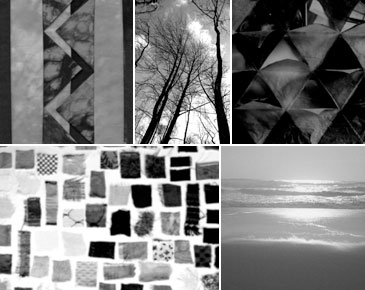
I used photos of various samples I’ve made – prints, patchwork, shibori, felt, stitch, sketchbook pages, paint and collage – and a photo of sunset over the sea, and displaced them using these five images:

displacement maps 

These were the results (mosaic thanks to Big Huge Labs). The numbers read across from top left and link to the images on Flickr:

displacements mosaic
1, 2, 3, 4, 5, 6, 7, 8, 9, 10, 11, 12

Next I’ll be looking at these along with the rest of the design work I’ve done for OCA Textiles 1 to find some interesting aspects to develop with fabric collage and appliqué techniques.

little pieces of fabric

I recently spent a happy couple of hours snipping samples of my fabric stash, which I’d sorted by colour in preparation for some collage exercises in my OCA Textiles 1 course. It reminded me why I love fabric as a medium. Partly the textures, the combination of warp and weft, its weight (or lightness), the way its colours and patterns work. And partly the associations and meanings that come with it, personal, historical and cultural nuances that enrich each tiny snippet beyond its visual and tactile qualities.

blues

greens

reds

purples

thinking about cloth and limitation

The first task for starting work on manipulating fabrics was to sort the fabrics into colour groups, and the course suggests two hours to do that and cut samples from each type of fabric for a pinboard. I have too many fabrics, I think! I will take a little longer over it because it’s a good motivation to get them organised so I know just what I have to work with. I always find sorting anything a bit of a challenge because I see too much as borderline (it’s the same with my filing cabinet). I knew that aspect of it would be hard, so I designated a pile for patterns and mixtures as well as the clearer colours and just threw anything too complex on that pile instead of spending time trying to make small decisions.

I sorted about half the fabric yesterday, and today I made some sample sheets, using only my own dyed fabrics. I’ve done them loose-leaf so I can keep them in a folder and add to them, and I’ll just pin up the whole sheets for reference. These are all cottons and silks, so tomorrow I’ll make some more sheets with other types of fabrics from the sorted colour boxes.

The idea is to make it easier to pick out the ‘right’ fabrics for collages to interpret some of my design work – it will certainly be more systematic than my usual method of just diving into an amorphous mass of colour and texture and pulling something out. I got out my copy of Jean Littlejohn’s Fabrics for Embroidery, as I thought it would be good background reading for this section of the course, and this kind of recording of fabric is the first thing she suggests – every time you get a new one, stick a little piece in your notebook… I should obviously have taken more notice when I first read it many moons ago!

fabric samples

On the subject of having too much fabric, Littlejohn points out that before the expansion of the fabric trade, people were limited to the materials in their local environment,

These limitations encouraged people to be endlessly inventive with the materials at their disposal.

I know I have a tendency to collect more, rather than using up what I have, not just new fabrics but new ‘must have’ products and new techniques as well. There’s a place for these, of course, but I think it’s also an important challenge for me to learn how to practise the traditional skills that my grandmother would have recognised, and to be inventive with the stuff I already have (some of which once belonged to her, in fact).

I was thinking about limitations and about the way people would use and reuse fabric in the past, and I did a mindstorm on the words wear/worn as the first step towards constructing a garment (or part of one) which comes a bit later in the course. That piece has to relate to and grow visually from the design work I’ve done so far, as well as what I’m about to do, but I think I also need to anchor it in some way, otherwise I’ll flounder. The work I did in January for Sharon’s Take it Further Challenge gave me a new sense of the power of limiting and channelling ideas, and it also showed me how much strength I personally can gain by playing with words and thoughts as part of the design process.


mindstorm

lost in the post

Update – They’ve found it!!!! My tutor got it back this morning and is going to send it again using guaranteed delivery. I’m laughing and crying all at the same time. Thanks so much for your kind thoughts.

Royal Mail have mislaid at least half a dozen things sent by us and to us over the past year – noticeably more than in previous years. The most recent and most distressing is my last OCA assignment (i.e. pretty well everything I did between July and November) – posted by my tutor on December 8th and there is so far no sign of it. I take a little hope from the fact that a cheque I sent to the B&B we stayed in on Islay last year was finally delivered at the beginning of December – just over 6 months after I put it in the post! But it’s only a little hope… most of the things that the Post Office lose seem to stay lost – they must have a huge black hole somewhere.

I’m so glad I’m blogging because otherwise I might not have any photos of the work at all, but from now on I’ll be photographing everything, and in more detail. I wish I had taken photos of more of the sketchbook pages too.

The thing that’s affecting me most right now is that throughout the course you’re asked to select from previous design work and develop it. Of course I still have the work from assignment 1, but now I also have this big gap in the process. I do feel demoralised by it (and I don’t yet know how it will impact on my final assessment) but I know all I can do is accept it and get on with the next part…

… which does sound exciting – fabric manipulation, beginning a theme book, and designing and making a small piece, which could be part of a garment or bag. You can do a wall hanging but they encourage you to do something three-dimensional and that’s what I want to do. I also need to decide on a subject for my theme book from the welter of possibilities tumbling about in my mind – elephants, islands, circles, cooking, knitting, skirts, hearts, words, worn, torn, edges, rifts… I’ll probably have to throw them all into a hat and pull one out at random…

assignment 2 is done!

I knew it had been a while since I last blogged but I was a bit surprised to see just how long. I have a good reason, though – I’ve been immersed in finishing my second assignment for OCA Textiles 1, finally put in the post (just) on time on Monday. It takes ages to get everything labelled and organised for sending to my tutor – I must try to do more of that as I go along. These are the two larger printing/painting samples I finished at the weekend. The top one is a repeating pattern that could go off the edges of the fabric – scrunch dyed cotton fabric, block printed with fabric paints, then stencilled with masking tape stencils in two layers, the first layer applied with a natural sponge, and the second layer applied with a sponge roller. When I’d done that, I thought the purple stripes were too strong against the background fabric, which was quite pale in places, so I painted the whole thing with thin turquoise paint and then rinsed it before setting.

The bottom one is a single unit inspired by log cabin patchwork. It’s all block printed, the ‘log cabin’ with funky foam blocks with holes punched into them, and the round shapes with carved erasers. The fabric is silk, and I used fabric paints as I wanted that brushy texture in the colour.

printed fabric

printed fabric

The next section of the OCA course is fabric manipulation and making an actual object like a bag or a waistcoat, which sounds great, but I must also finish the appliqué piece and get on with the final assessment for City & Guilds. I think if I really pull out the stops I might be able to finish it before my registration runs out in mid-December.